Personal Stories
Yemenite Jews and their descendants share memories of home, the long walk to Aden, the airlift to Israel, and the lives they built there.
Written Narratives
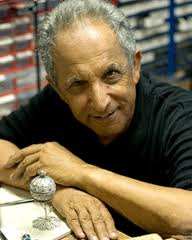
Yehuda Tassa
Yehuda Tassa: From Yemenite Jewish Traditions to Israeli Aviation and the Art of Filigree
Yehuda Tassa was born in Jerusalem in 1936 to a Yemenite Jewish family whose history reflects the religious devotion, artistic traditions, and challenges experienced by Jews in Yemen. An accomplished aeronautical engineer and master silversmith, Yehuda has dedicated much of his life to preserving the intricate art of Yemenite Jewish filigree, a craft passed down through generations of his family.
His parents immigrated to Mandatory Palestine in 1929, motivated by their longstanding aspiration to live in the Holy Land. Unlike many Yemenite Jews who arrived through organized immigration efforts, Yehuda's parents made the journey independently, without assistance from any organization.
Upon arriving, they initially settled in Kerem HaTeimanim, the Yemenite Jewish neighborhood of Tel Aviv, before relocating to Jerusalem, where Yehuda was born.
Yehuda grew up in a deeply religious Orthodox household. His father built a synagogue and served as a cantor, maintaining the religious traditions and liturgical melodies of Yemenite Jewry.
The family spoke Yemenite Arabic at home, and although Yehuda was born in Jerusalem, he considers the language his mother tongue.
Yehuda's family history includes painful experiences associated with the treatment of Jewish orphans in Yemen.
His father was orphaned at a young age in a country where Jewish orphans were subject to laws requiring their conversion to Islam. These laws, commonly associated with the Orphans' Decree, created profound insecurity for Jewish families and threatened the continuity of Jewish religious life.
Yehuda recalls that some Jews converted to Islam under pressure or because conversion offered opportunities unavailable to Jews, who faced various legal and social restrictions.
According to his family's history, his grandfather converted to Islam before eventually returning to Judaism. Yehuda explains that his grandfather's changes in religious affiliation did not affect his recognition as Jewish under Jewish religious law.
An especially remarkable story concerns one of Yehuda's uncles, who was orphaned in Yemen and converted to Islam under the prevailing laws.
The uncle eventually rose to become the Supreme Judge of Yemen.
His conversion created a complicated relationship with his Jewish relatives. Yehuda recalls that his aunt, the judge's sister, was reluctant to discuss her brother, whom she regarded as having been lost to the family through conversion. Nevertheless, the uncle maintained contact with his nephew, demonstrating that family relationships sometimes endured despite religious divisions.
Yehuda also describes how the threat of forced conversion affected Jewish girls in Yemen. He recalls that some orphaned girls, as young as 12 or 13, were married to significantly older Jewish men in an effort to protect them from conversion to Islam.
Beyond the Orphans' Decree, Yehuda remembers that Jews in Yemen faced limitations on their professions, movement, and economic opportunities. The severity of these restrictions varied depending on the political conditions and governing authorities.
Despite these challenges, Yemenite Jews maintained distinctive religious and artistic traditions, many of which were passed down within families over generations.
A Family Tradition of Yemenite Jewish Silversmithing
For generations, Yehuda's family specialized in the intricate art of Yemenite Jewish filigree, particularly the distinctive silverwork associated with Sana'a, the capital of Yemen.
Yemenite Jewish artisans were renowned for their mastery of jewelry making and precious metalwork. In Sana'a, silversmithing was a highly specialized profession, with workshops devoted to different stages of production, including fabrication, gold plating, and granulation.
Yehuda recalls that Sana'a once had approximately 300 jewelry workshops, each specializing in particular techniques.
Filigree involves twisting, shaping, and soldering extremely fine strands of silver or gold into elaborate decorative patterns. Granulation, an especially demanding technique, involves arranging tiny silver spheres into intricate designs and securing them through specialized metalworking processes.
These techniques were traditionally transmitted from father to son, with methods and formulas often guarded as family secrets.
Yehuda's father had been a respected master jeweler in Yemen before immigrating to the Land of Israel. He learned the craft from his own father and began teaching Yehuda when he was just six years old.
Yehuda recalls spending his earliest years as an apprentice performing repetitive tasks that required patience and precision.
“For the first few years, all I did was twist and flatten the silver wires that are used to form the basic frame structures. Then I progressed to soldering.”
As his skills developed, he learned increasingly complex techniques, eventually mastering the delicate processes involved in traditional Yemenite jewelry making.
Yemenite Jewish jewelry was valued not only for its beauty but also for its cultural and symbolic significance.
Traditional bridal jewelry often incorporated designs intended to represent fertility, health, prosperity, and the passage of life. Small silver spheres could symbolize fertility, while elongated shapes resembling peanuts represented prosperity.
During his research into traditional jewelry designs, Yehuda discovered an unusual bridal bracelet featuring a hemisphere and flower on one side and shapes resembling small houses on the other.
He explained that the house-like forms represented a tomb, serving as a reminder of human mortality even during the celebration of marriage.
Such symbolism reflected the close relationship between Jewish religious values, family traditions, and the decorative arts of Yemen.
From Traditional Education to Engineering
Much of Yehuda's early education took place at home, where he studied both the family profession and Jewish religious texts.
His upbringing emphasized Torah study, Hebrew, and Aramaic. Religious learning occupied an important place in family life, and he was raised according to traditional Yemenite methods of studying sacred texts.
Yehuda's childhood changed dramatically when his father died while Yehuda was only nine years old.
The family included six children, three of whom were younger than Yehuda. With the loss of his father, Yehuda faced considerable responsibility at an early age.
He left high school after just one year to help support his family, relying on the jewelry-making skills he had learned during his childhood apprenticeship.
For years, he worked as a craftsman alongside his older brothers, producing traditional Yemenite jewelry.
Despite his interrupted formal education, Yehuda possessed a strong aptitude for mathematics and science.
He recalls that a teacher or social worker had recognized his intellectual abilities during elementary school and helped him attend a private school in Jerusalem's Rehavia neighborhood.
By the age of 23, Yehuda realized that traditional jewelry making alone would not provide sufficient financial security for his future family.
Determined to pursue higher education, he began studying independently in the evenings.
After eight months of intensive preparation, he passed Israel's matriculation examinations, qualifying him to apply to institutions of higher education.
He subsequently passed the university entrance examinations and was admitted to the Technion–Israel Institute of Technology in Haifa.
There, Yehuda pursued his interests in mathematics, physics, and engineering, beginning a career that would eventually take him into the aerospace industry.
A Career in Israeli Aviation and American Aerospace Research
Following his studies at the Technion, Yehuda worked in a university laboratory before joining Israel's developing aviation industry.
He contributed to pioneering aircraft design efforts in Israel, participating in the early development of the country's aeronautical engineering capabilities.
While working in the Israeli aircraft industry, Yehuda met a visiting American professor who invited him to pursue doctoral studies at Case Western Reserve University in Cleveland, Ohio.
Yehuda accepted the invitation and moved to the United States, where he completed his Ph.D.
He subsequently worked at NASA and later at Lockheed, contributing to aerospace research and engineering.
His position at Lockheed eventually brought him to California, where he settled in Palo Alto.
Over the course of approximately four decades, Yehuda built a successful career as an aeronautical engineer, applying the same precision, patience, and technical skill that had characterized his childhood training as a silversmith.
Yet even as he pursued scientific innovation, the artistic traditions of his family remained an important part of his identity.
Reviving a Disappearing Art
After retiring from his engineering career, Yehuda returned to the craft he had first learned from his father.
His renewed involvement in Yemenite filigree began when he enrolled in a lapidary class through an adult education program.
For his final project, he created a necklace combining a polished gemstone with traditional Yemenite silver filigree.
His instructor was astonished by the intricate craftsmanship and asked who had made the necklace.
“I did,” Yehuda replied.
Recognizing the rarity of the technique, the instructor described Yemenite filigree as a disappearing art and asked Yehuda to teach her.
The encounter inspired him to investigate the state of traditional Yemenite Jewish silversmithing.
He discovered that relatively few artisans continued to practice the specialized techniques of filigree and granulation, even in Israel, where many Yemenite Jews had settled.
Earlier generations of master craftsmen had passed away, and opportunities to study the traditional methods had become increasingly limited.
Yehuda decided to devote himself to reviving and transmitting the craft.
Drawing upon his family's traditions, he resumed producing elaborate silver jewelry, including earrings, necklaces, and bracelets inspired by the distinctive designs of Sana'a.
He also creates Jewish ritual objects, including Hanukkah menorahs, mezuzah cases, and spice boxes, combining traditional techniques with religious and cultural symbolism.
Although he works primarily in silver, Yehuda sometimes incorporates precious and semiprecious stones into his designs. He also creates contemporary pieces that adapt Yemenite filigree techniques to modern jewelry styles.
Beyond his own artistic work, Yehuda has taught traditional silversmithing at institutions and workshops throughout Northern California, including the Mendocino Art Center and jewelry education programs in the San Francisco Bay Area.
He has authored two books on Yemenite filigree and shares examples from the collection of jewelry and metalwork assembled by him and his father.
Through his teaching, writing, and craftsmanship, Yehuda has worked to ensure that knowledge once transmitted privately from father to son can be passed on to new generations of artisans.
Preserving Yemenite Jewish Heritage
Outside his professional and artistic pursuits, Yehuda has enjoyed Israeli folk dancing, long-distance cycling, and spending time with his grandchildren.
His life reflects an extraordinary intersection of Jewish religious tradition, artistic craftsmanship, scientific education, and technological innovation.
Born in Jerusalem to parents who had independently immigrated from Yemen, Yehuda grew up surrounded by the language, customs, and religious practices of Yemenite Jewry.
His family's history included experiences of forced conversion, religious restrictions, and the challenges of maintaining Jewish identity in Yemen. Yet it also included generations of artistic achievement and the transmission of specialized knowledge through family relationships.
From his childhood apprenticeship in silver filigree to his career at the Technion, NASA, and Lockheed, Yehuda's experiences demonstrate how traditional craftsmanship and
Timeline of Jewish Presence