Mission, History, and Values

About JIMENA

Our Story

JIMENA was born from a conviction that remains at the heart of our work today: Jews from the Middle East and North Africa must have the opportunity to tell their own stories, in their own voices, and on their own terms.

How We Began

Two refugees, one shared concern

In the aftermath of September 11, 2001, Gina Bublil-Waldman, a former Jewish refugee from Tripoli, Libya, and Joseph Wahed z”l, a former Jewish refugee from Cairo, Egypt, came together around a shared concern. Public conversations about the Middle East were flattening a remarkably diverse region into simple narratives that erased Jews and other religious minorities from its history. At the same time, the American Jewish community was not adequately preserving or telling the stories of the nearly one million Jews who were forced out of or fled countries across the Middle East and North Africa in the twentieth century.

In 2002, after sharing their personal stories at a rally at San Francisco State University, Gina and Joseph recognized an urgent need for an organization that would let Jews from the Middle East and North Africa speak for themselves: to preserve their histories, pass on their cultures, and educate broader audiences, rather than have their identities and experiences interpreted by others. That year, with the support of many Bay Area Sephardic and Mizrahi Jews, they founded JIMENA.

Milestones

From a volunteer speakers bureau to a national voice

2001

After September 11, Gina Bublil-Waldman and Joseph Wahed z”l begin speaking out about the erasure of Jews from public conversations about the Middle East.

2002

JIMENA is founded in San Francisco, following a rally at San Francisco State University.

2002 to 2007

JIMENA operates as a volunteer speakers bureau, fiscally sponsored by JCRC San Francisco, bringing the testimonies of former Jewish refugees to college campuses.

2008

JIMENA becomes an independent 501(c)(3) nonprofit. Soon after, Gina Bublil-Waldman becomes the first former Jewish refugee from an Arab country to testify at the UN Human Rights Council in Geneva.

Today

JIMENA is a national organization working through empowerment, education, and advocacy, with research and archival partnerships with NYU, Brandeis University, and Ben-Gurion University.

More than two decades later, our founding principle remains unchanged. Our work ensures that Jews from the Middle East and North Africa are encountered in their full historical and human complexity, not reduced to political symbols, absorbed into someone else’s narrative, or asked to erase parts of themselves to fit today’s categories.

~1 million

Jewish refugees from the Middle East and North Africa whose stories we carry

3,000+ years

of continuous Jewish life in the Middle East

80+

universities across North America where our speakers have shared testimony

Since 2002

giving Sephardic and Mizrahi Jews a voice of their own

Where Our Voices Have Been Heard

Testimony at the highest levels

JIMENA speakers have testified before:

UN Human Rights CouncilU.S. CongressU.S. Department of StateCanadian ParliamentBritish House of LordsIsraeli Knesset

They have also brought personal testimony to more than 80 universities and hundreds of schools, synagogues, museums, and community institutions.

Why It Matters

A more complex Middle East, a more complete Jewish people

Mizrahi and Sephardic Jews complicate many of the categories through which the Middle East and Jewish identity are commonly understood. Their histories hold deep rootedness in the region alongside displacement from it; centuries of cultural exchange alongside periods of discrimination and persecution; Arabic, Persian, Ottoman, Babylonian, Kurdish, Amazigh, and other cultural influences alongside distinctly Jewish religious and communal traditions.

Their experiences challenge the binaries we often reach for:

1. East and West

Jewish communities who were part of the Middle East for millennia and also part of the wider Jewish world.

2. Indigenous and foreign

A people rooted in the region for more than 3,000 years, and too often treated as outsiders in it.

3. Arab and European

Cultures shaped by Arabic, Persian, Ottoman, and Amazigh worlds, beyond the European Jewish story most people know.

4. Diaspora and homeland

Communities who lived in exile and at home at the same time, and who rebuilt their lives across the world.

These histories resist reduction because the people themselves resist reduction. That complexity is not incidental to our mission. It is one of the reasons our work matters.

At a moment when Jewish identity and Middle Eastern history are compressed into competing political narratives, JIMENA insists on something more demanding: historical honesty, human complexity, and the right of Mizrahi and Sephardic Jews to define and pass on their own experiences.

JIMENA ultimately asks people to see more: not only a fuller history of the Middle East, but a fuller understanding of who the Jewish people are.

Mission

JIMENA’s mission is to safeguard, renew, and share the history, heritage, and rights of the one million Jewish refugees from the Middle East and North Africa and their Sephardic and Mizrahi descendants.

Vision

We envision a future where Sephardic and Mizrahi Jews are fully recognized, represented, and empowered to tell their own histories, define their own identities, assert their own legacies, and challenge narratives that erase, distort, or speak for them. We see a world where their voices, traditions, experiences, and historical memory are indispensable to understanding Jewish identity, the Middle East and North Africa, and histories of displacement and belonging.

Values

Justice

Din / דין

We carry forward the resilience of the one million Jewish refugees from the Middle East and North Africa, pursuing the justice, recognition, and redress their story has always deserved.

Memory

Zikaron / זיכרון

We are the keepers of our ancestors' voices, ensuring that the triumphs, traditions, and truths of Jews from the Middle East and North Africa are told, honored, and carried from generation to generation.

Truth

Emet / אמת

We tell our story with the integrity our people have always embodied, speaking with honesty and courage so our history is known as it truly was.

Explore More
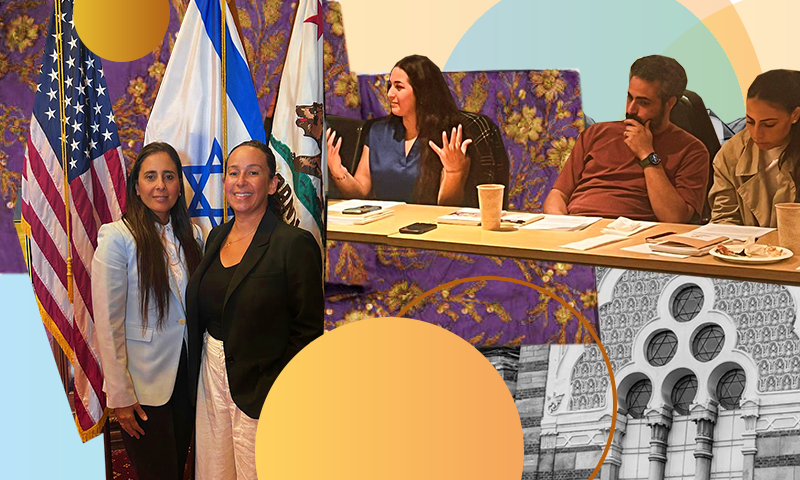
Who We Are
Get to know the team behind our work.
Meet Our Team

Annual Reports

Discover key findings and highlights from our work.
Explore Reports