Egypt: Jewish History
Jews lived in Egypt for more than 2,500 years, from the ancient garrison at Elephantine and the great community of Alexandria to the Cairo of Maimonides. In the twentieth century, a vibrant community of about 75,000 to 80,000 people was driven out through arrests, expulsions, and confiscations after 1948, 1956, and 1967. Today only a handful of Jews remain.
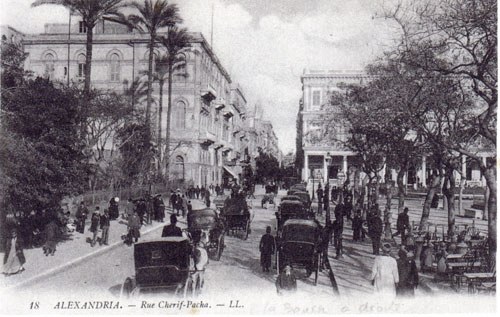
Sherif Pasha Street, Alexandria. On the right, the Stock Exchange building, where 90% of the brokers were Egyptian Jews (1945).
Jewish History
Explore the History of the Jews of Egypt
Jewish history in Egypt reaches back to the Bible and forward to the cafes and department stores of twentieth century Cairo and Alexandria. For more than two and a half thousand years, Jews lived along the Nile as soldiers, scholars, merchants, doctors, and artists. In the space of a single generation, that community was almost entirely uprooted.
2,500+ years of Jewish life in Egypt | 75,000 to 80,000 Jews in Egypt in the 1940s | 1948 to 1967 arrests, expulsions, and confiscations drive the community out |
Ancient roots
From Elephantine to Alexandria
The Bible tells of Joseph, the Israelites in Egypt, and the prophet Jeremiah, who fled to Egypt after the Babylonian conquest of Jerusalem. The earliest documented community is the Jewish garrison on the island of Elephantine, near Aswan, whose letters and contracts from the fifth century BCE still survive.
In the centuries after Alexander the Great, Alexandria became home to one of the largest Jewish communities in the ancient world. There, Jewish scholars translated the Hebrew Bible into Greek, the version known as the Septuagint, and the philosopher Philo wrote his works. The community was devastated after a failed Jewish revolt against Rome in 115 to 117 CE.
Medieval Cairo
Maimonides and the Cairo Genizah
Under Muslim rule, Jews lived as protected but unequal subjects, known as dhimmis. Fustat, the old city of Cairo, became a center of Jewish life. In 1166, the great philosopher, physician, and rabbi Moses Maimonides settled there, and wrote his most famous works in Egypt.
For centuries, the community of the Ben Ezra Synagogue in Fustat stored worn out papers in a room called a genizah. Rediscovered in the 1890s, the Cairo Genizah holds hundreds of thousands of fragments, including letters, contracts, poems, and shopping lists, that give a rare window into everyday Jewish life around the medieval Mediterranean.
A modern community
Cairo and Alexandria
In the nineteenth and early twentieth centuries, Egypt's growing economy and the opening of the Suez Canal in 1869 drew Jews from across the Ottoman Empire and Europe. The community grew to about 75,000 to 80,000 people by 1948. Jews founded banks and department stores such as Cicurel, worked as lawyers, doctors, and clerks, and shaped Egyptian music and film: the beloved singer Laila Mourad and the filmmaker Togo Mizrahi both came from Jewish families.
The community was diverse. It included ancient Egyptian Arabic speaking families, Karaite Jews, Sephardic families from Turkey and Greece, and Ashkenazi Jews from Europe. Many held foreign passports or none at all, which left them vulnerable as Egyptian nationalism grew.
Rising danger
1945 to 1954
In November 1945, rioters attacked the Jewish quarter of Cairo and burned a synagogue. After the State of Israel was founded in 1948, hundreds of Jews were arrested and Jewish property was seized. Between June and November 1948, bombings in the Jewish quarter and at Jewish owned stores killed about 70 Jews and wounded nearly 200.
Laws requiring companies to employ mostly Egyptian nationals cost many Jews their jobs. In 1954, the arrest of a spy ring made up of young Egyptian Jews recruited by Israeli intelligence, known as the Lavon Affair, was used to cast suspicion on the entire community.
Expulsion
1956 and 1967
After the Suez Crisis of 1956, when Britain, France, and Israel attacked Egypt, the government of Gamal Abdel Nasser turned against the Jewish community. About 1,000 Jews were imprisoned, hundreds of businesses were seized, and thousands were stripped of their nationality or expelled. Many were forced to sign statements that they were leaving voluntarily and giving up their property. About 25,000 Jews, nearly half the community, left within months, often with one suitcase and very little money.
During the Six Day War in 1967, nearly all Jewish men were arrested and held for months, some for more than three years, in the prisons of Abu Zaabal and Tura. By the early 1970s, almost all of Egypt's Jews had gone, to Israel, France, Brazil, the United States, and beyond.
Today
Synagogues without a congregation
Only a handful of elderly Jews still live in Egypt. The community, led by Magda Haroun in Cairo, cares for synagogues and cemeteries. In recent years Egypt has restored several historic sites, including the Eliyahu Hanavi Synagogue in Alexandria, which reopened in 2020.
Living heritage
Egyptian Jewish culture today
Egyptian Jews carried a cosmopolitan culture with them: Arabic, French, Italian, and Ladino spoken at the same table; dishes like ful medames, sofrito, and the slow cooked eggs called beid hamine; the songs of Laila Mourad and the films of Togo Mizrahi; and memories of synagogues in Cairo and Alexandria that still stand today.
Explore further
Keep exploring
Key dates in the history of the Jews of Egypt, at a glance. |
The laws that shaped the rights and lives of Jews in Egypt. |
Watch Egyptian Jews tell their own stories. |
Languages, music, food, and traditions. |
Dishes for Shabbat, holidays, and every day, and the stories behind them. |
Histories, memoirs, novels, and children's books in JIMENA's library. |
For the classroom
Questions to discuss
- Many Egyptian Jewish families spoke several languages at home and at school. What does that tell you about life in Alexandria and Cairo?
- How did the events of 1948, 1956, and 1967 change life for Egypt's Jews?
- Many Egyptian Jews left with almost nothing. What does it mean to lose your citizenship and property along with your home?
Sources: History of the Jews in Egypt; 1948 Cairo bombings; Cairo Genizah.
Policies
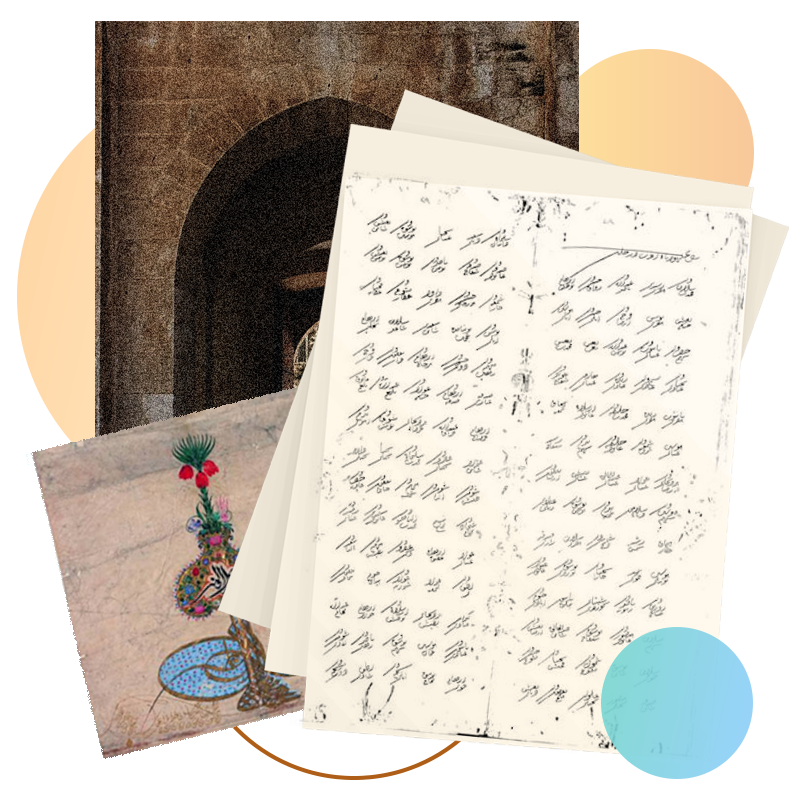
Timeline of Jewish Presence