Personal Stories
Uncover the hidden narratives and vibrant legacy of the Jewish community. Explore the personal journeys shared below.
Written Narratives
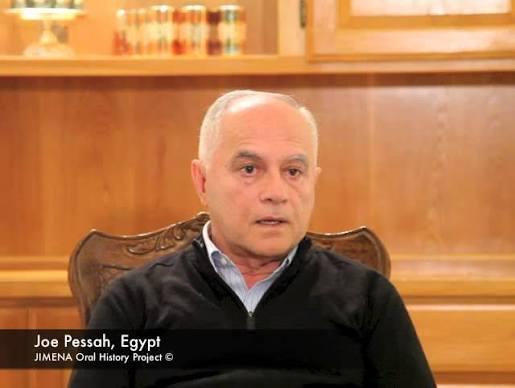
Joe Pessah: Jewish Life and Imprisonment in Egypt
Originally published July 18, 2013
Joe Pessah was born in Cairo, Egypt, into a large Karaite Jewish family with seven children. The family lived on a street originally named Farouk, later renamed al-Jaish, or “Army Street.” Joe's family had lived in Egypt for generations, with ancestral roots possibly extending to Russia, Istanbul, and the Land of Israel.
Joe has vivid memories of his grandparents, whom he describes as being “like saints,” full of wisdom and humility. Although they had little money, he remembers them as rich in character. His mother grew up in poverty, watching other children wear new clothing while she wore tattered shoes, even during the winter months.
Despite the hardships, Joe recalls many wonderful aspects of Jewish life in Egypt. He visited his synagogue every evening, creating some of his fondest childhood memories. He remembers spending summers along the Egyptian coast and dancing at night. Joe takes pride in the generations of Egyptian Jews who contributed to the country's art, film, healthcare, and economy. Their legacy endured even as the Jewish community's departure accelerated.
Joe was raised with a deep appreciation for his Karaite Jewish heritage. For Karaites, or Karaim in Hebrew, Shabbat observance was particularly strict, reinforcing the day's holiness. His family walked to synagogue, and his mother shared stories from the Torah while preparing traditional Karaite dishes that could be eaten without reheating.
These included stuffed chicken, tagarine, a thin noodle resembling angel hair pasta, and bamya, or okra, served with rice. Among Joe's most cherished memories of Egypt is the aroma of za'atar, a traditional Middle Eastern spice blend.
Although Karaite Jews maintained distinct religious traditions, Joe recalls friendships with Rabbinic Jews during his childhood. The extent of interaction between the communities varied over time. Friendships were common, but marriage between Karaite and Rabbinic Jews was traditionally prohibited in order to maintain their respective religious practices.
For Joe, the greatest concern was not assimilation into Egyptian society but the possibility that the Karaite community might lose its ancient traditions. Karaite bar mitzvah observances were generally more modest than those of Rabbinic Jews, and the community maintained its own distinctive musical traditions.
Joe remains deeply moved by the story of his parents' marriage. Under prevailing Egyptian marriage customs, a woman's family was expected to provide a dowry, making marriage difficult for women of limited means.
Joe's mother, who came from a poor family, accompanied a friend to visit the man who would become Joe's father, a prosperous dentist. He fell in love with her and vowed to marry her regardless of her financial circumstances. Later, he established an organization to assist impoverished women seeking to marry.
Joe's mother devoted herself to raising her children, encouraging their education, and shielding them from the growing antisemitism surrounding them.
Joe remembers an incident when he was 12 years old. His father sent him to purchase groceries in the Jewish Quarter, but along the way, a Muslim boy blocked his path and harassed him. The experience left Joe frightened and anxious about encountering similar hostility in the future.
Throughout his childhood, antisemitism increasingly affected Joe's sense of security and belonging. He remembers waking at dawn to watch Jewish families leave for the train station as they fled Egypt. Eventually, he became reluctant to form friendships, fearing that his friends would soon disappear from his life.
Joe also experienced discrimination at school. Determined to excel in Arabic, he worked hard to become the top student in his class. Yet his teacher repeatedly placed him second, refusing to recognize him as a true Egyptian or to accept Arabic as his native language.
Joe remembers lowering his head in helplessness and crying, “What can I do!”
In 1952, political unrest and anti-British demonstrations erupted into widespread violence in Cairo. Joe recalls watching a mob force its way into his school, located across the street from his home. Soldiers barricaded the school gates as rioters destroyed shops displaying signs in English.
By 1955, the situation for Egyptian Jews had deteriorated further. Joe vividly remembers the arrest and execution of Dr. Moshe Marzouk, a Karaite Jew from Cairo, and Shmuel Azar, who were convicted of participating in an Israeli espionage and sabotage network.
Their public executions were among the most traumatic events of Joe's youth. He was particularly disturbed by Egyptian media reports describing how long Dr. Marzouk's pulse continued before he died.
The Six-Day War of 1967 brought another devastating turning point for Egypt's remaining Jewish community. Joe recalls the atmosphere of hostility in Cairo, where students received weapons training and public messaging encouraged the destruction of Israel.
He listened as Egyptian radio broadcasts spread false reports about the war. Despite the growing danger, Joe remained hopeful that conditions would improve and chose not to abandon his life in Egypt.
One morning, Joe awoke to the sound of his mother crying. Officers from al-Mabahith Amn al-Dawla, Egypt's state security police, had taken his father away.
The family was assured that he would be detained for only a few minutes of questioning. Instead, his father remained imprisoned for three years.
Joe feared that he and his brother, both students at Cairo University, would also be arrested. For a month, they remained hidden inside their home, terrified that the authorities would come for them.
Eventually, there was a knock at the door. Joe, his brother, and a cousin who had also been hiding in the house were apprehended and taken to police headquarters for interrogation.
They brought two boxes of university materials, hoping to prove that they were students rather than Israeli spies.
Joe and his brother were interrogated for more than six hours. Although neither was charged with a crime, Joe, his brother, and his cousin were sent to Tora Prison, where Egyptian Jewish men were being detained.
Conditions at Tora were brutal. Upon arrival, the prisoners' heads were shaved. They slept on the floor with only a sheet for bedding and were given a single set of clothing and one eating utensil.
To maintain their sanity, Joe and his fellow prisoners challenged one another with trivia questions, intellectual exercises, and other games.
The prison held inmates in communal cells, with Jewish and Muslim prisoners separated. During periods outside his cell, Joe befriended imprisoned members of the Muslim Brotherhood.
He remembers being impressed by their solidarity and the ways they supported one another. Although Joe recognizes that relations between Jews and the Muslim Brotherhood have changed over time, he recalls that they were able to coexist peacefully in prison.
At the time, he understood the Brotherhood's principal struggle to be against Egypt's secular government, which its members hoped to replace with a system based on Islamic religious law.
Most nights, Joe dreamed of freedom. Older prisoners attempted to raise the spirits of younger men by assuring them that their release was approaching.
The Jewish prisoners sometimes received small privileges from guards in exchange for using their professional skills and talents. These moments offered Joe a fleeting sense of dignity and independence.
Together, the prisoners also learned to sing Hatikvah, Israel's national anthem.
The highlight of each month was a visit from Joe's fiancée, Remy. Only 19 years old when Joe was imprisoned, she remained devoted to him and tirelessly advocated for his release, making repeated appeals to the police and the Red Cross.
Determined to marry Joe despite his imprisonment, Remy surprised him one day by arriving with a rabbi and two wedding rings.
Separated by prison bars, the couple exchanged vows and were married.
Joe eventually learned that the Jewish prisoners would soon be released. Through friendships with workers inside the prison, he had arranged to receive word if the authorities began discussing their freedom.
When a worker overheard conversations about their impending release, Joe proudly shared the news with his fellow Jewish prisoners.
Soon afterward, they were freed.
Their freedom, however, came with a condition: they could not remain in Egypt.
The men were transported directly to the airport for deportation, carrying little more than the equivalent of five U.S. dollars.
Joe remembers the surreal contrast between sleeping on a prison floor and, just hours later, sitting aboard an airplane while flight attendants served him hot chocolate and other treats he had not enjoyed in years.
After Joe arrived in France, Remy joined him several days later. When members of the French Jewish community learned about their extraordinary marriage, they offered to organize a second wedding celebration.
Joe's mother, saddened that she had missed her eldest son's wedding, arranged yet another celebration when the couple eventually arrived in the United States.
Joe laughs when recalling that he and Remy were married three times.
Joe's imprisonment was one of approximately 500 cases involving Egyptian Jewish men detained in the Abu Zaabal and Tora prison camps following the Six-Day War. These men were imprisoned not for crimes they had committed, but because they were Jewish.
Today, Joe compares the persecution of Egyptian Jews to the suffering of the biblical Israelites under Pharaoh. Their lives were made bitter, their property was confiscated, and their centuries of contributions to Egyptian society were disregarded.
Yet Joe believes that Judaism teaches the importance of living in the present rather than remaining consumed by the past.
His feelings toward Egypt remain complicated. He is grateful to have escaped persecution but saddened by the suffering and political violence that continue to affect the country of his birth.
He remains troubled by the hatred he believes is perpetuated through education and the media, describing it as another kind of “weapon of mass destruction.”
At the same time, Joe cherishes his memories of Egyptian life and maintains a deep belief in the kindness of ordinary Egyptians.
Above all, he dreams of a future in which political violence comes to an end and Egypt and Israel can live side by side in peace.
Timeline of Jewish Presence