Personal Stories
Uncover the hidden narratives and vibrant legacy of the Jewish community. Explore the personal journeys shared below.
Written Narratives
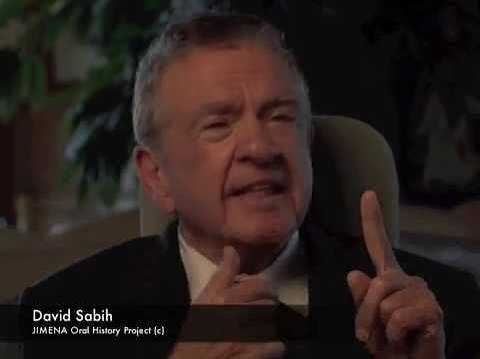
David Sabih
David Sabih: From a Privileged Childhood in Baghdad to a New Life in Israel and America
David Sabih was born in Baghdad, Iraq, in 1934, into a prosperous Jewish family. Raised in an affluent neighborhood, he enjoyed a comfortable childhood surrounded by Muslim, Christian, and Jewish families. His life changed dramatically after he witnessed the public hanging of a Jewish man accused of supporting Zionists. The experience strengthened his Jewish identity and ultimately prompted him to leave Iraq in 1950. His testimony traces his journey from Baghdad through Iran to Israel and eventually the United States, reflecting on displacement, family separation, and the Jewish values that continued to shape his life.
Growing Up in an Affluent Jewish Family in Baghdad
David grew up in a prosperous household in Baghdad, where his father worked as a successful lawyer representing prominent members of Iraqi society.
His father's professional standing afforded the family considerable privilege and social acceptance. David recalls that his father was treated almost “like a Muslim,” reflecting the respect he enjoyed among his predominantly Muslim clients and associates.
David's surname, Sabih, means “early morning” in Arabic.
His mother was a homemaker, and the family employed three live-in servants. They lived in an affluent neighborhood where most of their neighbors were Muslim.
David attended a private Jesuit school alongside children from wealthy Jewish, Christian, and Muslim families.
He remembers the school as an inclusive environment where students from different religious backgrounds studied and socialized together.
There was “no discrimination whatsoever,” he recalls.
Although David grew up in an observant Jewish household, he did not participate in Jewish youth movements or communal organizations.
His family's privileged circumstances also insulated him from many of the difficulties experienced by other Iraqi Jews.
Looking back, David describes his childhood as a “bubble life.”
He acknowledges that he was largely unaware of the poverty and antisemitism affecting parts of Baghdad's Jewish community.
While he generally felt comfortable in his own neighborhood, he remembers sensing an atmosphere of fear when visiting Jewish neighborhoods elsewhere in the city.
These contrasts would become increasingly significant as the political situation in Iraq deteriorated.
A Public Hanging That Changed His Life
One incident profoundly altered David's understanding of his Jewish identity and his future in Iraq.
While traveling to school, he witnessed the body of a Jewish man hanging in public.
The man had been accused of supplying weapons to Zionists.
For David, who had grown up feeling relatively protected by his family's wealth and social standing, the sight was deeply disturbing.
It exposed him to the dangers facing Jews in Iraq and challenged his belief that his family's privileged position could guarantee their security.
The experience became a turning point.
David began to identify more strongly with the Jewish community and concluded that he needed to leave Iraq.
He reached out to the American Jewish Joint Distribution Committee, commonly known as the JDC or the Joint, seeking assistance in immigrating to Israel.
Escaping Iraq Through Iran
David initially attempted to leave Iraq with a group of ten people.
Their plan was to cross the border into Iran and continue to Israel.
However, the group was arrested before completing the journey and sent back to Baghdad.
David was imprisoned, but his father used his influence and financial resources to secure his release by bribing officials.
Following this unsuccessful attempt, David's father took responsibility for arranging a safer route out of the country.
He organized David's travel to Tehran, where David joined a camp for Jewish emigrants receiving assistance from the Joint Distribution Committee.
In 1950, David finally reached Israel.
He settled in Bat Yam, where he lived with his uncle.
Unlike some immigrants who struggled to adjust to their new surroundings, David recalls feeling comfortable in Israel.
The move represented both an escape from growing insecurity in Iraq and an opportunity to establish a new life.
Education and a New Beginning in Israel
David continued his education after arriving in Israel.
During his first three years in the country, he completed high school and pursued technical training at the Technion.
His interest in engineering would eventually shape his professional and educational ambitions.
In 1955, David moved to the United States to continue his engineering education.
His journey from Baghdad to Bat Yam and then to New York reflected the opportunities and challenges of rebuilding a life after displacement.
Although he established himself outside Iraq, the circumstances of his family's departure continued to affect him.
Family Separation and the Loss of His Father
David recalls that his parents remained in Baghdad for a period after his departure and helped other Jews leave Iraq for Israel.
He does not know the full details of their activities but remembers that they assisted members of the Jewish community seeking to escape.
Eventually, nearly everyone in David's household left Iraq, including the family's live-in servants.
His father, however, remained behind.
David and his relatives lost contact with him and were unable to determine the circumstances of his later life.
According to David, his father died sometime in the 1980s, but the family never learned the details surrounding his death.
The uncertainty became one of the lasting losses associated with David's departure from Iraq.
Although Baghdad had been his childhood home, David expresses no desire to return.
His memories of privilege and security are overshadowed by the violence he witnessed and the painful separation from his father.
Jewish Identity and Values Across Generations
After settling in the United States, David did not become particularly involved with Iraqi Jewish communal organizations.
Nevertheless, his Jewish identity remained deeply important to him.
He emphasizes the moral and ethical principles he associates with Judaism and the importance of passing those values to his children.
For David, Jewish identity is expressed not only through religious observance or communal affiliation but also through the responsibility to treat others with dignity and respect.
His testimony reveals the contrasting experiences of Iraqi Jews in the mid-20th century.
Although David enjoyed a privileged childhood and positive relationships with people of different religious backgrounds, his family's wealth and social position could not shield him from the growing dangers facing the Jewish community.
The public hanging he witnessed transformed his understanding of belonging and security, setting him on a journey that took him from Iraq to Israel and eventually the United States.
David Sabih's story preserves the experiences of an Iraqi Jewish refugee whose life was shaped by both privilege and persecution, the determination to pursue an education, and the enduring importance of family and Jewish ethical traditions.
Timeline of Jewish Presence